If you’ve ever dealt with heating or cooling systems in planes, satellites, or spacecraft, you know regular thermostats don’t cut it up there. As a bimetal thermostats supplier, I’ve spent years fielding calls from aerospace engineers asking why our standard off-the-shelf units just don’t work once they leave Earth’s atmosphere. The truth is, bimetal thermostats for aerospace aren’t just “bimetal thermostats with a pretty box”—they’re built for a list of super-specific, non-negotiable requirements that most folks in the industrial or HVAC world never have to think about. Let’s break down what makes these thermostats different, and why getting every detail right can mean the difference between a smooth satellite orbit and a costly mission failure. Bimetal Thermostats
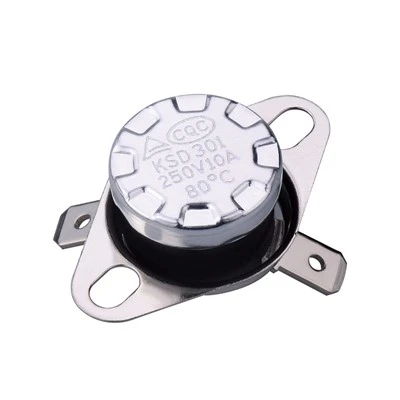
First off, let’s ground this in what a basic bimetal thermostat does, super quick: two different metals fused together bend when heated, right? That bend flips a switch to turn equipment on or off. But on a commercial jet or a Mars rover, that bend has to be precise—like, down to a fraction of a degree precise. Earth’s atmosphere might have small temperature swings, but space? You’re dealing with wild extremes. In low Earth orbit (LEO), a satellite can go from -150°C when it’s in the planet’s shadow to +120°C when it’s in direct sunlight. A bimetal strip that works at room temp will either bend way too much at high heat (cause a false switch) or not enough at cold heat (miss a critical adjustment). So our first big requirement is thermal stability across a way wider temperature range than any consumer unit.
But it’s not just the range—it’s how the strip holds up over time. Aerospace missions aren’t days or weeks; a geostationary satellite might stay up 15+ years. Every time that bimetal strip bends to flip a switch, that’s a tiny amount of wear. On Earth, a thermostat might cycle a few times a day, but a satellite? It cycles every 90 minutes, because it orbits the Earth every 90 minutes. That’s 5,800 cycles a year. Over 15 years, that’s 87,000 cycles. A cheap bimetal strip from a hardware store would warp or lose its shape after a few thousand cycles. So we have to use metal alloys that are super resistant to “fatigue”—that’s the word for when metal gets weak from repeated bending. We test our aerospace units to 100,000+ cycles to make sure they don’t give out mid-mission. I’ve had an engineer tell me once that their old supplier’s unit failed after 3 years because the bimetal strip fatigued; they had to do a emergency spacewalk to swap it. That’s the kind of problem we’re here to solve.
Next, vacuum compatibility. Space is a vacuum, right? Most regular thermostats have seals, plastics, or coatings that outgas—meaning they release tiny gas molecules when they’re in low pressure. Outgassed molecules stick to satellite optics, solar panels, or sensors, and that messes up how the satellite works. If a thermostat’s seal releases gas, it could cloud a camera lens or block solar panels, cutting power to the whole craft. So for aerospace, every single material we use has to meet strict outgassing standards—like NASA’s SP-8007 or ESA’s ECSS-Q-70-02A. No cheap plastics, no adhesives that leave residue. We use metal seals instead of rubber, and we bake all parts before assembly to drive out any trapped gases. It’s an extra step, but it’s non-negotiable. I remember a time a customer tried to cut costs by using a standard silicone seal on a test thermostat; when we put it in a vacuum chamber, it released enough gas to fog a test sensor. We had to redo the whole unit, but it saved them from a $10M satellite failure later.
Then there’s vibration and shock. When a rocket launches, it’s not like driving down the highway—vibration levels can hit 1,000 g’s (that’s 1,000 times the force of gravity). Imagine trying to flip a light switch while someone hits you with a sledgehammer. The bimetal strip has to stay aligned through all that shake. If the strip shifts even a little, the switch won’t engage right. So we mount the bimetal strip with hardened, precision-machined brackets, not just a little plastic clip. We also test every unit on a shaker table that mimics rocket launch vibration, and we drop them from 1 meter (spacecraft drop testing for landers, basically) to make sure no parts come loose. Most of our industrial customers never ask about this, but for aerospace, it’s make-or-break.
Wait, also—electrical integrity. A thermostat’s switch has to make a reliable connection when it flips. On Earth, dust or humidity might cause a little resistance, but in space, you can’t have any stray electrical current causing a short. Aerospace thermostats are often used to control heaters for fuel lines, avionics, or camera sensors. If the switch arcs (sparks) when it flips, that could ignite explosive propellant or damage sensitive electronics. So we use gold-plated contacts—gold is super conductive, doesn’t corrode, and doesn’t arc in low pressure. No cheap tin contacts here; they’d corrode in space and fail. We also test the switch for arcing in a vacuum chamber at our lab; if it sparks at all, it’s sent back to the shop.
Another thing: accuracy in non-terrestrial environments. On Earth, air pressure affects how heat transfers, right? A bimetal thermostat works by heat expanding the metal, but in space, there’s no air to carry heat away. So a thermostat calibrated at 25°C on Earth might read differently in a vacuum. We have to calibrate our units in a vacuum, controlled environment, not just a room temp lab. That way, when it’s on a satellite, it triggers the heater exactly when the avionics need it, even with no air around. I’ve seen engineers get this wrong before—they calibrated a standard thermostat on Earth, stuck it on a deep space probe, and it failed to turn on the heater, freezing the fuel line. That probe was lost, and it set back their mission by a year. No one wants to be that guy.
Also, weight. Every pound you put on a rocket costs thousands of dollars to launch. Regular bimetal thermostats are heavy because they’re made for big HVAC systems. We have to make our aerospace units as light as possible, without sacrificing strength. So we use thin, high-strength alloys for the bimetal strip, and aluminum housings instead of steel. We cut every part down to the minimum, but we never skimp on the critical stuff—like the seal or the contact material. It’s a balance, but it’s one we’ve mastered over the last decade. Our units are 30% lighter than standard industrial bimetal thermostats, which saves our customers money on launch costs.
Wait, let’s not forget radiation. Space is full of cosmic rays and solar radiation, which can break down materials, especially plastics and rubbers. Regular thermostats don’t have to deal with that, but in LEO or deep space, radiation can make a seal crack or a wire degrade over time. So all our materials are radiation-hardened. We test parts in a radiation chamber to make sure they don’t lose their properties after being exposed to high levels of radiation. A rubber seal that works on Earth would turn brittle after a few months in space and leak, so we use metal alloys that can take that radiation hit.
I know this sounds like a lot, and a lot of customers might not realize how different aerospace thermostats are from what they use on the ground. But here’s the thing: as someone who’s been in this business for 12 years, I’ve seen time and again that cutting corners on these requirements doesn’t save money—it costs way more. A $500 aerospace thermostat is way better than a $50 industrial one that causes a $10M mission failure. That’s why we don’t just sell thermostats; we work with engineers from the design phase, helping them pick the right alloy, the right contact type, the right calibration for their specific mission.
Whether you’re building a satellite for weather monitoring, a lander for Mars, or a commercial jet’s cabin heating system, we can customize a bimetal thermostat to meet your exact specs. We test every unit in our own lab—temperature range, cycle life, vacuum, vibration, radiation—so you don’t have to worry about it failing. If you’re working on an aerospace project and your current thermostat supplier is giving you a hard time about any of these requirements, reach out. We’re here to answer questions, share test data, and help you get the right part for your mission. Don’t wait until it’s too late—your equipment deserves a thermostat that’s built for space, not for a basement workshop.
Bimetallic Strips References:
- National Aeronautics and Space Administration (NASA). (2020). "Outgassing Requirements for Spacecraft Materials" (NASA SP-8007).
- European Space Agency (ESA). (2018). "Space Product Assurance: Thermostats for Space Applications" (ECSS-Q-70-02A).
- American Society for Testing and Materials (ASTM). (2019). "Standard Test Methods for Vibration Testing of Aerospace Components" (ASTM F519-19).
- International Organization for Standardization (ISO). (2021). "Space Systems: Thermal Control Devices" (ISO 14801:2021).
Yueqing Ganen Electronic Technology Co., Ltd.
As one of the most professional bimetal thermostats manufacturers and suppliers in China, we also support customized service. Please feel free to wholesale advanced bimetal thermostats in stock here from our factory. Welcome to contact us for quotation.
Address: No.6 yonghe 3rd Road, Chengdong Industrial Functional Zone, Chengdong Street, Yueqing City, Wenzhou City, Zhejiang Province, China.
E-mail: daiaohui@163.com
WebSite: https://www.ganensj.com/
